Showing posts with label book review. Show all posts

Wednesday, July 7, 2010

Growing Object-Oriented Software Guided by Tests

I've just finished reading Growing Object-Oriented Software, Guided by Tests (Beck Signature) it is without doubt a very good book (I'd go so far to say the best book I have read this year).
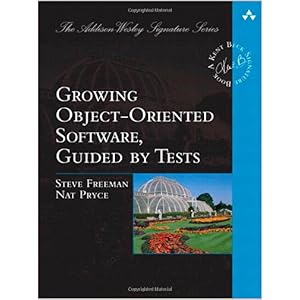
Book cover: Growing Object-Oriented Software, Guided by Tests

Understanding how to do agile development well is not something you learn and then are finished with, it is something that you can always do better...

The first part of the book is about the fundamentals, and the rest is then applying to an example project. This involves creating user stories, the high level architecture and writing the acceptance, unit test and finally the functioning code - all at one vertical slice at a time. By this I mean that they show how you can evolve the architecture and code during the development process - something that is hard to understand without a worked example.

Going back over the fundamentals, with the clarity of these authors really taught me a lot. And the example allowed you to see what thay mean. The book is short and the diagrams nicely done - well recommend this one.

Tuesday, June 30, 2009

Gregor-grams and Chappell-grams

I've been doing a lot of work with an Enterprise Services Bus (ESB), and found Enterprise Integration Patterns: Designing, Building, and Deploying Messaging Solutions a very useful book - especially the diagram techniques "Gregor-grams".


These are useful for diagramming any message based system - I'm very keen on UML but it does not really address MOM systems in the large. Below is a Gregor-gram showing how a Sales Order Process might integrate SFdC, Zuora (Z-Billing) and Oracle Financials (a pattern that most businesses will need):

This diagram allows us to show how message move through the system and are transformed. There's also another good book is Chappell's Enterprise Service Bus which is focused on the ESB implementation of MOM (no surprise given the name!).

It has another diagramming techique, which at the moment I'm using for creating a static view of the ESB:
This is closer to a static UML view (deployment maybe), but it also allows you to express how the components connecting to an ESB exchange messages (HTTP/WCF etc). I feel that Gregor-grams are better for the dynamic view. The book never names these diagrams, so 've taken to calling them "Chappell-grams" given that they are meant to be an evolution of Gregor-grams.

Using Gregor-grams and Chappell-grams together allows us to document how a system works from both a dynamic and static view.

Wednesday, May 27, 2009

Regular Expressions Cookbook

The Regular Expressions Cookbook looks like a good addition to any programmers bookshelf


It is well written and concise and has lots of very useful receipes - such as URL/Paths/Addresses manipulators (getting host, frame, email address etc), and some very useful ones for specific formats, such as date formats, phones numbers, zip and UK postocdes. What's really impressive is the book provides useful links to reference materials (RFCs, Telecoms standards, British and ISO standards).

Tuesday, May 12, 2009

7 ± 2 rule of diagrams

Reading "The Elements of UML(TM) 2.0 Style" by Scott W. Ambler I came across the 7 ± 2 rule of diagrams:
"16. Reorganize Large Diagrams into Several Smaller Ones

It is often better to have several diagrams showing various degrees of detail than one complex diagram that shows everything. A good rule of thumb is that a diagram shouldn’t have more than nine symbols on it, based on the 7 ± 2 rule (Miller 1957), because there is a limit on the amount of information that someone can deal with at once. “Wallpaper” diagrams, particularly enterprise data models or enterprise object models, may look interesting but they’re too information-dense to be effective. When you are reorganizing a large diagram into several smaller ones, you may choose to introduce a high-level UML package diagram (Chapter 6)."

which is based on The Magical Number Seven, Plus or Minus Two: Some Limits on Our Capacity for Processing Information by George A. Miller in 1956

Scott's book is full of useful tips, and some nice links like this one!

Thursday, April 2, 2009

NASA gives some telling insights into software

An illuminating report by NASA "NASA Study on Flight Software Complexity" has much to offer people involved in software, be they programme manager, developer, tester, architect etc - I wish this was a book already! I'm seriously going to read the whole thing (even at 264pp) because even a one hour skim has given me so much already - truly a must read!

One of the most AMAZING things was, how many lines of code are in a GM car? when I saw the answer I had to get the rest of the team to answer the question - one of them could not even understand that there would be any lines of code in a GM car! check out the graph:

Yep, that's right, by 2010 there will 100 million lines of code in an average GM car - jaw dropping! how many bugs would you expect in 100 million? - now if GM build their code to the same level as NASA and other flight companies (good luck with that) then according to NASA (Appendix D)
"For the new manned space program we should probably expect close to 10 Million lines of flight code, and one to two orders of magnitude more ground software. If we go by industry statistics, a really good (but expensive) development process can reduce the number of flaws in software to in the order of 0.1 residual defects per one thousand lines written. A “residual defect,” for all clarity, is a defect that shows up after the code has been fully tested and delivered with an industry-standard rigorous testing process. A system with a million lines of code, then, should be expected to experience at least 100 defects while in operation. Not all these defects will show up at the same time of course, and not all of them will be equally damaging."
OMG - even if GM write aeronatics quality code then an average GM car in 2010 will have 10,000 defects. Now there's a reason to get into testing as a job ;-)

Saturday, March 28, 2009

The Long and the Short of it

I've just finished reading The Long and the Short of it: A Guide to Finance and Investment for Normally Intelligent People Who Aren't in the Industry by John Kay. Of all the investment books I've read recently it's a star performer. why?


Like any book in this area it gives a background to investing and the process - which has been handled very well. It covers the efficient market debate quite well, and gives a very good insight into the CAPM (capital asset pricing model) and SEU (subjective expected utility). There are points where I felt it could have done with some more charts/illustration, but on the whole its an easy enough read.

The reason it's a star performer is simple: it's shows you why & how you can outperform the big trading shops, traders and analysts (specifically that they have to target short-term results). The coverage of how to put together a portfolio based on overall low risk (from having uncorrelated risky investment), rather than the classic "perceived" low-risk portfolio (from selecting correlated low risk investments) is very enlightening.

So well worth a read and deserves a place on any investors book shelf...

Friday, March 20, 2009

Getting Things Done with Remember The Milk (GTD w RTM)

I've been reading "Getting Things Done" (GTD) by David Allen, a book on how to organize yourself effectively in an information rich world. It's a nice lifehack to improving time management and making work/life easier by getting everything (tasks, ideas, projects) out of your head onto paper/disk.

I've also been playing with Remember the Milk (RTM) as a way of implementing GTD, it's a very simple system, but being able to tag tasks and organise them online and your phone is very useful. It really shows how poor Outlook is at basic task management.

Monday, July 14, 2008

Designing Interactions

Just been reading Designing Interactions, which is a real eye opener of a book.

Reading about how products were designed and created and seeing the common threads of why they were successful makes this book a must have.

Its quite humbling to see some of the ideas that were being created in the 60/70s that we still think are new features for a product...